
Now, here’s our labor market insights for June 2026, written by Matt Duffy:
By nature, I’m an optimist. I tend to see the good in almost any situation. Even when circumstances look bleak, I believe the pendulum eventually swings back toward the positive.
That said, I also recognize that I’m not always right (something my wife reminds me of daily). As a result, I occasionally temper my optimism until a clearer trend emerges. And because I’m Irish, I worry. A lot.
In fact, much to the chagrin of my family and colleagues, I literally schedule time on my calendar (twice each month) to worry. Worry and anxiety are two of my superpowers. When channeled correctly, they force you to pay attention to the things that matter most.
Last week, during my one-hour worry session, something unusual happened. For the first time in a long time, I didn’t spend a lot of time worrying about the labor market. Granted, my daughter had just graduated from high school, so I dedicated a healthy portion of that hour to worrying about her (while simultaneously feeling incredibly proud of her 😊).
Today, I want to say out loud something I’ve been thinking for several months – the labor market is improving. I may regret putting that statement into the universe, but enough data points have accumulated to give me confidence in voicing what has quietly been sitting in the back of my mind.
Before I explain the reasons for my optimism; however, it’s important to acknowledge six signs of distress that we shouldn’t ignore.
- Hiring remains weak (the hiring rate is 3.2% – historically low)
-
- Companies are not laying off many workers, but they are also not hiring many workers.
- People who already have jobs are generally okay, but people looking for jobs are struggling to get hired.
- Long-term unemployment is rising
- The share of unemployed people who have been out of work for 27+ weeks rose to 27.5%, up from 20.4% a year earlier.
- Job growth is concentrated in a few sectors
- Job growth is concentrated in just three sectors – (1) Leisure & Hospitality; (2) Government; (3) Healthcare.
- Broad economic strength should produce job growth across many industries, not just a handful.
- White-collar workers face a much tougher market
- Several key industries are stagnant or shrinking – in particular, (1) Finance; (2) Banking; (3) Technology
- Specifically, the following workers are being hit the hardest:
- Recent college graduates
- Tech workers
- IT professionals
- Finance workers
- Professional business services workers
- Career mobility is unusually low
- A healthy labor market usually has workers switching jobs, pursuing promotions, and finding better opportunities – this is not the case in today’s labor market.
- Today’s data is comparable to the early 2010s, when the labor market was much weaker.
- AI and economic uncertainty are causing companies to be selective
-
- If consumers spend less, businesses become more cautious about hiring, which has created several issues
- Inflation remains a problem
- Lower- and middle-income households are struggling
- Rising costs reduce consumer demand
- If consumers spend less, businesses become more cautious about hiring, which has created several issues
Now, here are six reasons why I’m on the side of optimism.
- Job growth is significantly above what’s needed
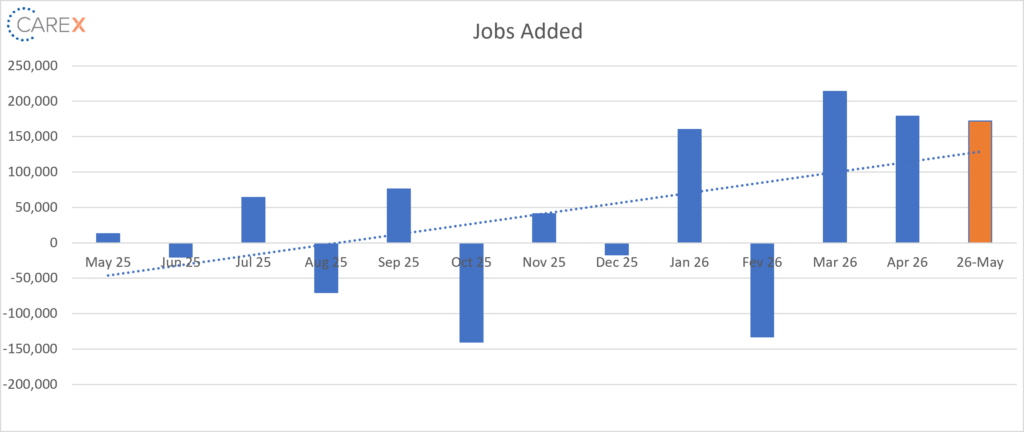
- The economy added 172,000 jobs in May .
- March and April numbers were revised upward by a combined 93,000 jobs.
- Many economists estimate that the U.S. only needs ~75k jobs per month to keep unemployment stable because of slower population growth.
- Current job growth isn’t merely positive; it is well above replacement level.
- Unemployment remains low
- Current unemployment sits 4.3%; historically, ~5% was often considered normal.
- During recessions unemployment typically rises above 6%, 8%, or even 10%.
- Layoffs remain very low
- Layoffs remain close to pre-pandemic averages.
- Contrary to headlines, the economy is not seeing widespread job destruction.
- In a weak labor market, layoffs surge. That is not happening. Instead, employers appear reluctant to fire workers because labor remains difficult to replace.
- Prime-age employment is near record highs
- For workers aged 25–54: Labor-force participation remains very high.
- When prime-age employment is strong, economists generally view the labor market as healthy.
- The labor market is adapting, not collapsing
- The AI discussion is often framed negatively, but another interpretation is emerging – AI-related hiring is increasing (specifically IT consulting postings are up sharply).
- Information-sector wages rose faster than any other sector.
- Nearly half of job postings now require AI-related skills, this suggests the economy is reallocating labor rather than eliminating it.
- Historically, technological shifts often create anxiety during the transition period even while total employment remains strong.
- The labor market’s biggest problem is selectivity, not weakness
- A recurring theme is that it’s hard to get hired (sadly, it is), but it’s also hard to get fired.
- However, that’s different from a truly weak labor market. In a recessionary labor market:
- Hiring falls.
- Layoffs rise.
- Unemployment rises.
-
- Today:
-
-
- Hiring is slower than ideal.
- Layoffs remain low.
- Unemployment remains low.
- Payroll growth remains positive.
-
The labor market may be less dynamic than in 2021–2022, but by historical standards it remains remarkably (and surprisingly) healthy.
In other words, the labor market may feel difficult for job seekers in certain sectors (tech, finance, recent graduates), but the aggregate data still looks much closer to “healthy but slowing” than “weak.”
By the Numbers:
- New Jobs – The U.S. added 172,000 jobs in May
- Leisure and hospitality led all sectors with 70,000 jobs, local government added 55,000, and Healthcare (which has been the leading sector) contributed 35,000
- The cynical question is this – how well-paying those roles? Are these new jobs tracking with inflation?
- Unemployment remained unchanged at 4.3%
- Unchanged for three straight months
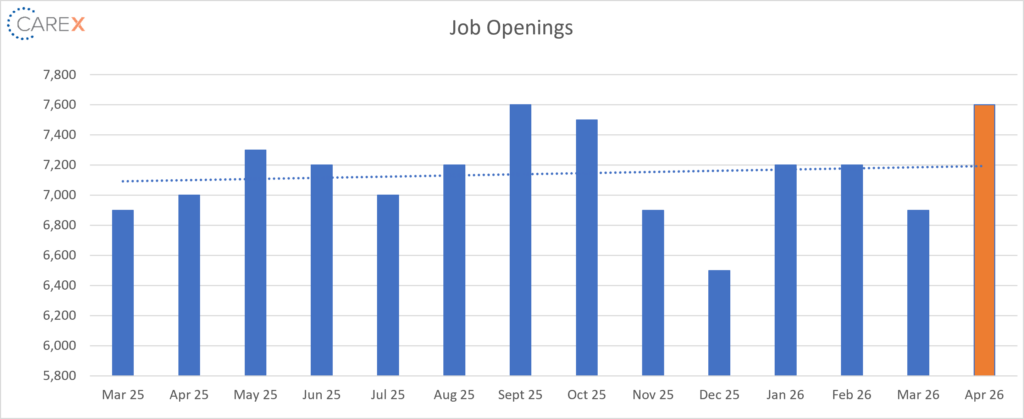
- Job openings surged to 7.6 million, up from 6.9 million the previous month
- The highest level in nearly two years
- By industry, nearly all of the openings came from the professional and business services category, which added 668,000 positions
- Hires decreased to 5.1 million down from 5.6 million the previous month
- Note: This is the most concerning trend on my radar.
- The hiring rate dropped to just 3.2% down from 3.5% the previous month
- Layoffs dropped slightly to 1.7 million, down from 1.9 million the previous month
- The layoff rate dropped to 1.1%
- Quits dropped slightly to 3 million, down from 3.2 million the previous month
- Quits, which are seen as a measure of worker confidence in the ability to change jobs and find another one continues to remain very low
- Total separations decreased to 5 million, down from 5.4 million the previous month
- Total separations were little changed in all industries
- Jobs per available worker sits at 1:1
- Up from 0.95 the previous month

To make sure you never miss a Labor Market Insights update, you can subscribe to receive reminders via email! While you’re here, make sure to check out the other resources we have available.