

Now, here’s our labor market insights for May 2026, written by Matt Duffy:
The tone of this month’s Labor Market Insights introduction may sound more personal than professional (and maybe it is) but I assure you the two are equally connected.
I often fall victim to the recency effect – especially when it comes to my Labor Market Insights reports. It’s a cognitive bias that causes me to overweight recent experiences and use them as the lens through which I interpret the labor market. Over the past two weeks, two events heavily influenced my thinking…birthday parties.
Within a two-week span, I celebrated a friend’s 50th birthday and my father’s 80th. While the two events were vastly different, they shared something meaningful in common – large groups of friends, family, and current/former colleagues coming together to celebrate milestone moments. The attendees at each gathering were incredibly diverse, with only one true common denominator – the birthday honoree. Both my friend and my father were surrounded by remarkable people – kind, supportive, thoughtful, and genuinely fun to be around. Driving home from each event, I kept coming back to something my father has often said: “you are who you surround yourself with”.
I spend a great deal of time analyzing the labor market, but at my core, I’m in the business of talent acquisition – my company, Carex, helps companies hire people. And hiring the right people matters immensely. Over the course of a lifetime, roughly one-third of a person’s life is spent working alongside coworkers. While the labor market continues to shift and uncertainty clouds which technical skills are – and will remain – in demand, one thing feels constant – hiring good human beings matters. A lot. Maybe more than any other factor.
The people who elevate teams and strengthen companies simply by being good colleagues have an impact that extends far beyond business results. They shape culture, influence morale, and ultimately improve the quality of our lives.
From a labor market data perspective, the latest jobs data is best described as stable, but hardly strong. The trend line I’m watching most closely remains the gap between hiring and quit rates.
Hiring activity came in ~1% above the pre-pandemic average, while quit rates were nearly 9% below during that timeframe. Outside of recessionary times, we rarely see workers quitting at levels this low.
Those dynamic signals three important things:
- Most hiring activity today is tied to newly created roles rather than replacing departing employees
- Slower job switching will weigh on wage growth. Historically, workers who change jobs see significantly higher compensation increases than those who stay put, so reduced mobility has a direct impact on wage acceleration.
- Worker confidence remains remarkably weak. Employees are showing far less willingness to take career risks or test the market than we would typically expect in a healthy labor environment.
By the Numbers:
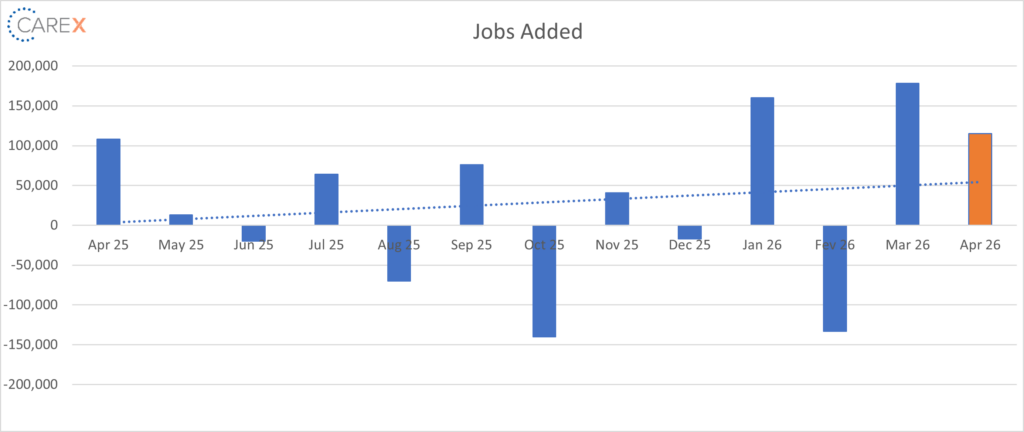
- New Jobs – The U.S. added 115,000 jobs in April
- An important note to consider: The jump of ~40k seasonal jobs will likely get revised down, putting underlying hiring closer to ~50k per month (in the breakeven range given demographics and tight immigration policy).
- Unemployment remained unchanged at 4.3%
- Newly unemployed jumped 358,000
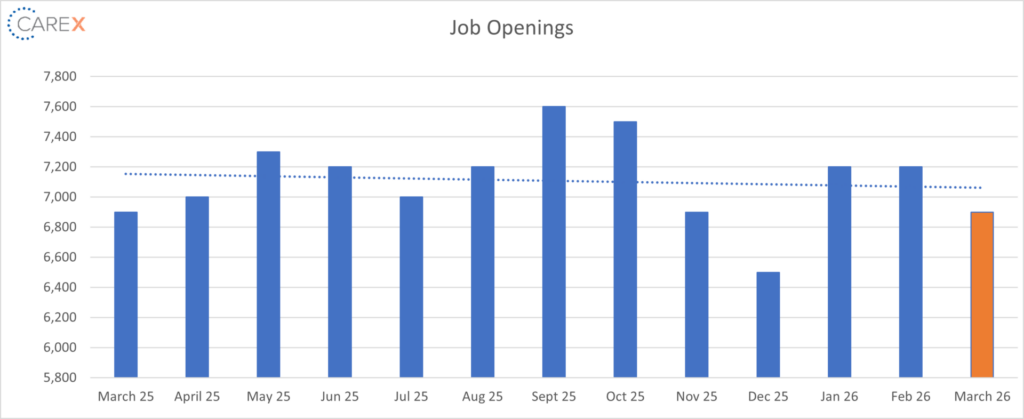
- Job openings remained unchanged at 6.9 million
- Job openings declined in professional and business services by 318,000
- Job openings increased in finance and insurance by 98,000
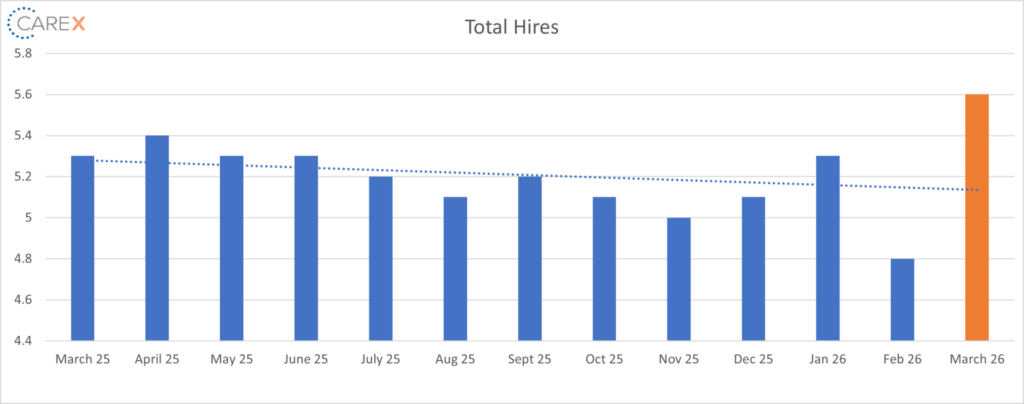
- Hires increased to 5.6 million, up from 4.8 million the previous month
- The hiring rate jumped to 3.5%, up from 3.1% the previous month
- The number of hires increased in transportation, warehousing, and utilities (+108,000), and edged up in professional and business services (+165,000) and in accommodation and food services (+124,000)
- Hires in Government continued to drop (7,000)
- Layoffs increased to 1.9 million, up from 1.7 million the previous month
- The layoff rate sits at 1.2%
- Quits increased to 3.2 million, up from 3 million the previous month
- Quits, which are seen as a measure of worker confidence in the ability to change jobs and find another one continues to remain very low
- Total separations increased slightly to 5.4 million, up from 5 million the previous month
- Total separations were little changed in all industries
- Jobs per available worker sits at 0.95:1
- At its peak in 2022, the ratio was 2:1
To make sure you never miss a Labor Market Insights update, you can subscribe to receive reminders via email! While you’re here, make sure to check out the other resources we have available.