

Now, here’s our labor market insights for October 2026, written by Matt Duffy:
I talk about the Labor Force Participation Rate (LFPR) a lot. Probably more than is socially acceptable.
When people ask me to describe today’s labor market, my go-to words have become “fluid” and “delicate.” And of all the labor-market data we track, much of that assessment comes back to one number – the LFPR. We’re approaching a massive shift in the U.S. labor market, one that will eventually touch every state, industry, and profession. Think of it like an approaching storm. We can already see the dark clouds. The wind is picking up and unfortunately, this is not one of those storms that blows over in 20 minutes.
The LFPR is simply the percentage of the civilian population age 16+ that is either working or actively looking for work. Here’s what it has looked like over the past 20 years:
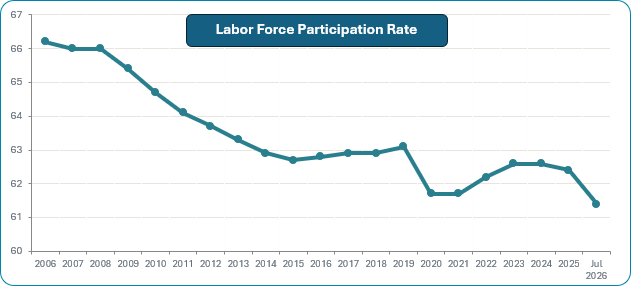
There continues to be a narrative that Americans have somehow lost their work ethic, that people simply don’t want to work anymore. I don’t buy it. The story is far more nuanced than “Americans stopped working.” And, ironically, the biggest explanation is pretty simple – Americans got older.
At the same time, for decades we’ve been having fewer babies, which, inconveniently, is where future workers tend to come from. The data on prime-age workers (ages 25–54) makes this much clearer. Compare 2006 with today:
- Overall LFPR: ~66.2% – ~61.8%
- Prime-age LFPR: ~82.9% – ~83%
In other words, the people we traditionally think of as the core working-age population are participating in the labor force at roughly the same rate they were 20 years ago. We didn’t suddenly stop working. We got older. Millions of baby boomers moved from workers to retirees. Younger people started entering the workforce later. COVID accelerated retirements. And more recently, immigration-driven labor-force growth has slowed.
Now put that into actual people. If the U.S. still had its 2006 labor-force participation rate, roughly 13 million more Americans would be in the labor force today. And the demographic math isn’t getting any friendlier. If the LFPR continues falling toward roughly 60% by 2030 (as it is expected to do), the available workforce gets squeezed even further – exiting another ~6M workers.
In other words, if your long-term workforce strategy is “don’t worry, more people will show up,” I have another unfortunate chart for you. Young adult LFPR.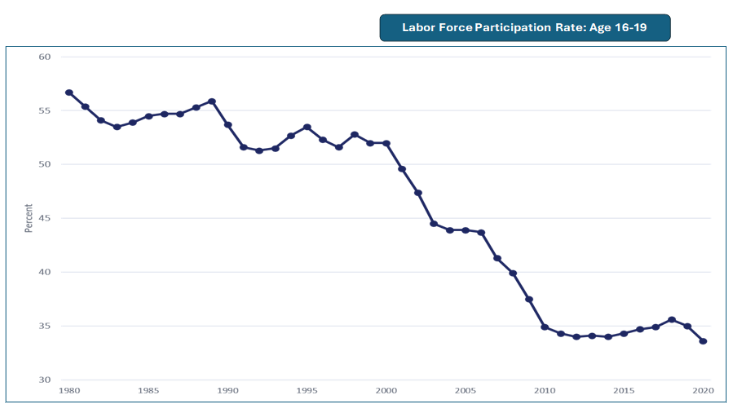
I’m less worried about whether “kids these days” want to work and more concerned about whether we’re giving them enough opportunities to start working. Entry-level jobs increasingly compete for adult workers. Remote work can make it harder for young employees to learn by simply being around experienced coworkers. AI is beginning to affect some of the occupations traditionally used as entry points into professional careers. And many employers are offering fewer internships and early-career opportunities.
That’s potentially a much bigger problem than it appears. Because today’s teenager working a first job isn’t just filling a shift. They’re learning how to show up on time, deal with a difficult customer, communicate with a manager, solve problems, work on a team, etc. Those experiences become tomorrow’s workforce.
Which brings us back to the bigger issue. Like any product, talent is a supply-and-demand market. It just happens to involve humans. When workers were plentiful, the strategy was relatively easy – “we’ll just hire someone else.” As the supply of available workers tightens, that strategy becomes much more expensive – and sometimes simply doesn’t work. Companies will need to think differently about how they attract, retain, develop, deploy, and maximize talent. Every employee becomes a resource worth investing in rather than a position that can easily be refilled.
By the Numbers:
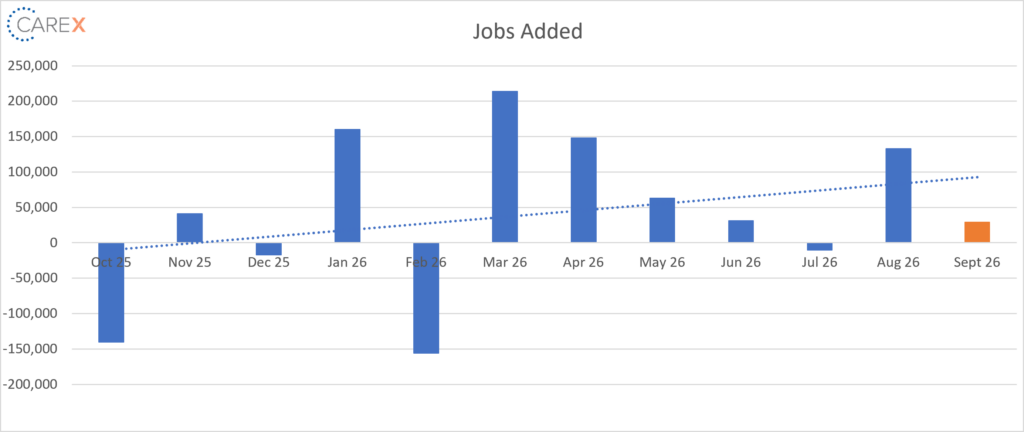
- New Jobs – The U.S. added 29,000 jobs in September
- The month’s gains can be attributed largely to the healthcare sector, which added 17,000 jobs
- Revisions to July and August subtracted a combined 60,000 jobs
- Through September, the economy has added an average of 68,000 jobs per month
- Unemployment increased slightly to 4.2%, up from 4.1% the previous month
- The unemployment rate continues to hold steady and/or fall largely because people are leaving the labor force
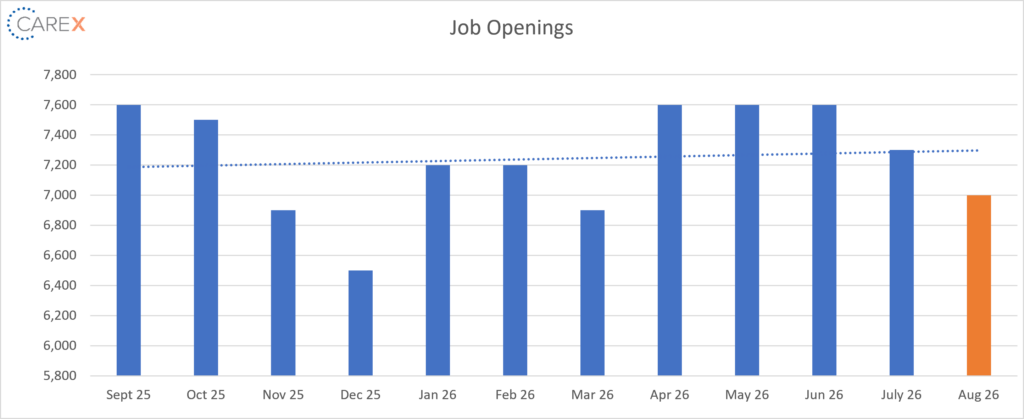
- Job openings dropped slightly to 7M, down from 7.3M last month
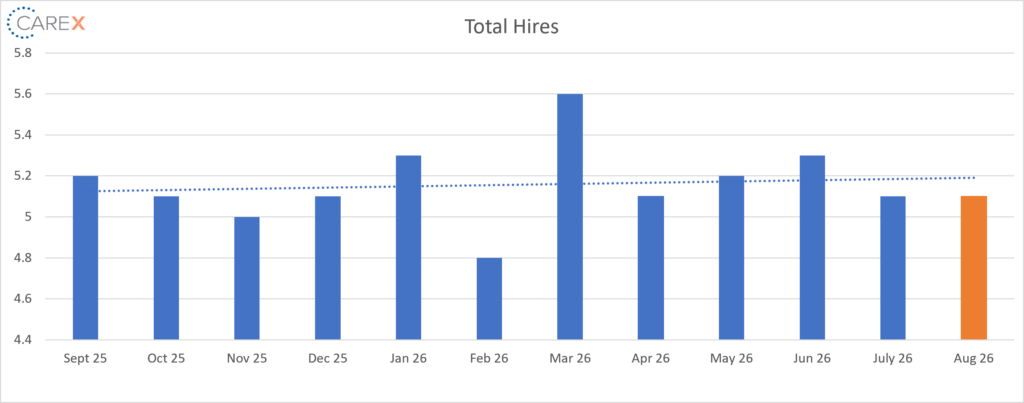
- Hires increased slightly to 5.2M, up from 5.1M the previous month
- The hiring rate ticked up to 3.3%
- Layoffs dropped slightly to 1.6M, down from 1.7M the previous month
- Marking a 7-month low
- Quits remained unchanged at 3.1M
- Quits, which are seen as a measure of worker confidence in the ability to change jobs and find another one continues to remain very low
- Total separations remained unchanged at 5.1
- Total separations were little changed in all industries
- Jobs per available worker remained unchanged at 1:1
- Up from 0.95 five months ago
To make sure you never miss a Labor Market Insights update, you can subscribe to receive reminders via email! While you’re here, make sure to check out the other resources we have available.