

Now, here’s our labor market insights for December 2025, written by Matt Duffy:
The U.S. Labor Market through the lens of National Lampoon’s Christmas Vacation.
Note: Because of the Government shutdown, we received a tranche of data from October and November. The following narrative and “By the Numbers” section takes into consideration two-months of data.
Over the weekend (while waiting for the final jobs report to be released) I wrote my December Labor Market Insights report. It was my typical dull summary filled with mind numbing data about population shifts and the dichotomy of the hiring and quit rate(s). Then, Sunday evening my family watched National Lampoon’s Christmas Vacation (as we do every year!); and I found myself re-writing it through the lens of the movie. Maybe it was the glow of the Christmas tree lights (or the eggnog), but I’ll forgo the typical format and channel my inner Clark Griswold for this month’s edition. If you haven’t seen the movie, this month’s update may fall flat (heck, even if you have seen it, it still may fall flat!).
The U.S. labor market has officially entered its National Lampoon’s Christmas Vacation era, where confidence is high, reality is low, and everyone keeps pretending this is all part of the plan.
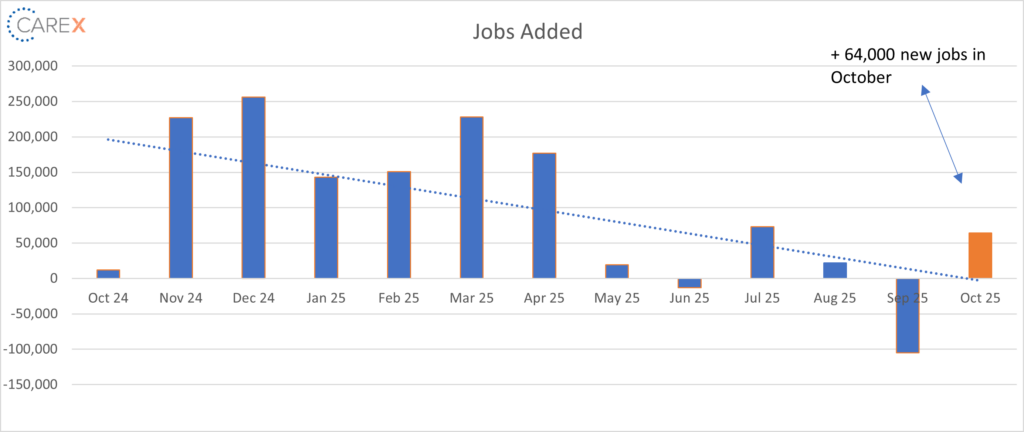
Hopeful beginnings: Clark keeps telling everyone this is going to be a “fun, old-fashioned family Christmas,” but by November, reality sets in. Unemployment rises to 4.6%, the highest in four years, and the economy adds just 64,000 jobs. That’s the equivalent of Clark finally flipping the switch on the Christmas lights…only to get nothing. Technically, effort was made. Results? Not so much.
Then the October data is released: The part of the movie where things really start to spiral. The BLS estimates about 105,000 jobs were lost, partly because deferred resignations from the Department of Government Efficiency finally took effect at the end of September. These were decisions made months earlier, much like Clark’s non-refundable pool deposit, and now everyone’s stuck dealing with them.
Enter Uncle Eddie: Just when the labor market thought things couldn’t get more complicated, Uncle Eddie pulls into the driveway. He means well, insists everything is “under control,” and brings a level of unpredictability that nobody budgeted for. Unlike the Labor Market, “the sh*tter is full”.
And then Eddie does what Eddie does best: creates a mess so big it breaks the system. Thanks to the shutdown, October didn’t even get an unemployment rate, the first time in nearly 80 years that data collection failed. Economists opened the report, looked around, and realized someone had just emptied the RV sewer into the statistical process. No numbers, no explanation; just a strong sense that something went very wrong.
Uncle Eddie doesn’t single-handedly ruin Christmas, but he doesn’t help. He shows up unexpectedly, drains resources, and leaves everyone else scrambling to explain what happened. Much like the labor market right now, his presence turns what was already a stressful situation into a full-blown holiday spectacle.
The Department of Government Efficiency resignations really shine: Those deferred departures, decided earlier in the year but finally taking effect at the end of September are pure Eddie energy. They didn’t show up right away, but when they did, they took out an estimated 105,000 jobs in October, parked themselves in the data, and refused to move. Nobody asked for this disruption, but now everyone must work around it.
Zoom out: The holiday montage isn’t getting any cheerier. Over the past six months, the nation has added only 100,000 jobs total. Most of those came from health care, which is basically the Aunt Bethany of the labor market – confused, relentless, and always showing up no matter what. Thanks to America’s aging population, health care keeps hiring. Nearly every other sector, meanwhile, looks like the Griswold Christmas tree: either not growing at all or actively losing branches.
In Summary: So here we are, standing in the front yard with Clark, staring at the house, and waiting for the big payoff. The lights aren’t working, the numbers are missing, and most industries aren’t hiring, but we’re still being told to smile and sing along. At this point, the labor market isn’t getting a cash bonus. It’s getting a jelly-of-the-month club and being told to make the best of it.
By the Numbers:
- New Jobs – the U.S. added 64,000 new jobs in November
- We lost 105,000 jobs in October
- The U.S. added a mere 100,000 jobs in the past six months
- The bulk of job gains were in health care, an industry that is almost always hiring due to America’s aging population
- Unemployment increased to 4.6% up from 4.3% since the last report
- There are now 7.8 million Americans out of work
- Job openings increased to 7.6 million, up from 7.2 million since the last report
- The bulk of the job openings in October were in the trade, transportation, and utilities sector, with 239,000 vacancies, mostly at retailers
- Job openings in the accommodation and food services sector fell 33,000 (the federal government had 25,000 fewer vacancies)
- Hires fell to 5.1 million, down from 5.3 million the previous report
- The hiring rate remains stuck at levels last seen in 2013, when the U.S. economy was still emerging from the Great Recession
- Layoffs remained essentially the same at 1.8 million
-
- The layoff rate has moved upward very slowly, over the past few months the layoff rate has ticked up to 1.2%, compared to 1.1% this fall
- Quits dropped to 2.9 million, down from 3.2 million the previous report
- Quits, which are seen as a measure of worker confidence in the ability to change jobs and find another one continues to remain very steady – and very low
- Total separations dropped slightly to 5.1 million, down from 5.2 million the previous report
- Total separations are down primarily because of the extremely low quit rate
- Jobs per available worker fell to 0.99:1
- At its peak in 2022, the ratio was 2:1


To make sure you never miss a Labor Market Insights update, you can subscribe to receive reminders via email! While you’re here, make sure to check out the other resources we have available.